
Following Rice Straw Through a Cooperative’s Circular Business
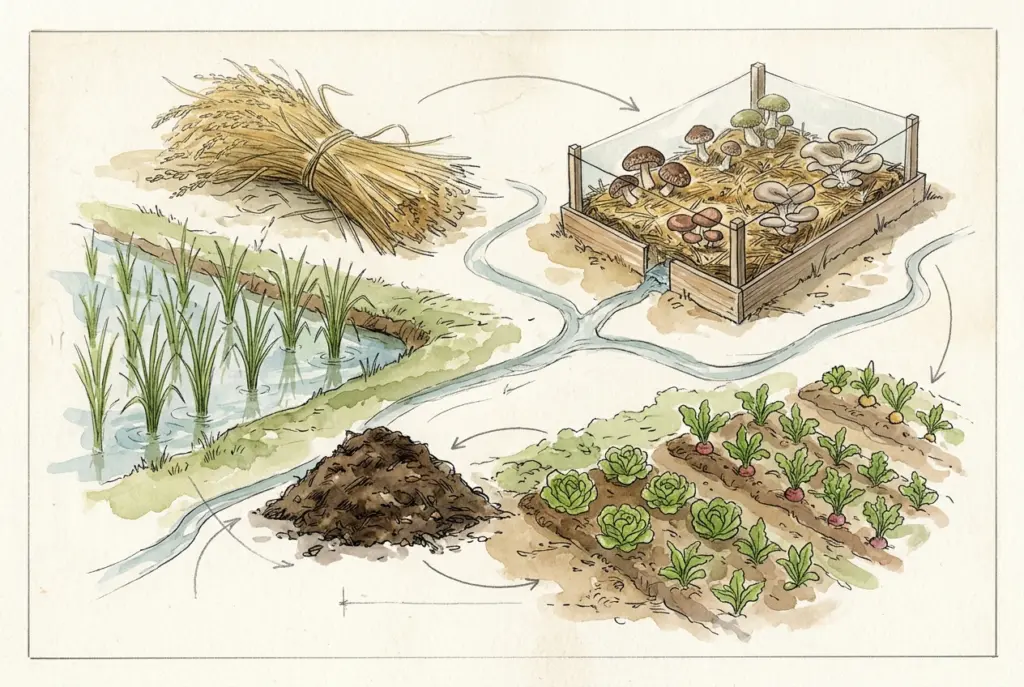
Rice straw is not simply a residue left behind after harvest. In New Green Farm Cooperative’s account, it becomes a material moving between several activities: mushroom cultivation, compost production and crop growing. The important mechanism is the connection between those steps. Straw that might otherwise be burned or left to decompose in flooded fields is instead brought into a production chain.
The cooperative, established in 2023 with seven core members, was still developing its business. Rice and vegetables were its main activities, while mushroom production was limited. Straw mushrooms were grown by traditional methods on small, separated plots, leaving the activity exposed to weather and environmental conditions. Five members were directly involved.
Following the straw through the system
The approach introduced to the cooperative through work involving the International Rice Research Institute (IRRI) and partners links several material flows. Fresh straw is used to cultivate mushrooms. After that crop, spent mushroom substrate and other agricultural residues are transformed into organic fertilizer. The fertilizer is then returned to rice, fruit trees and vegetables.
This sequence changes the role of straw in the farm system: it is both a growing medium and an input to a later stage. The account also describes mechanized rice-straw composting as part of the approach. Mechanization matters here as a feature of the process, but the supplied information does not specify the equipment, its capacity or how it changed the volume of straw the cooperative could handle.
There is also a water-and-soil question behind the change in handling. The source notes that some straw had been incorporated into flooded fields, where decomposition could affect water and soil quality. That wording identifies a possible concern, not a measured effect in this case. The account does not report water-quality or soil measurements, so it cannot show how conditions changed after the cooperative adopted the new pathway.
What the business story can—and cannot—show
The case presents circular production as a way to broaden the uses of one harvest’s residue. Instead of relying only on rice and a small amount of mushroom income, the cooperative could connect mushroom production with fertilizer-making and multiple crops. The source attributes lower farming costs, new revenue streams and expanded local employment to the enterprise.
Those reported benefits make the story worth examining, but the excerpt offers no figures for costs, sales, jobs, yields, straw volumes or changes over time. It also does not compare the cooperative with farms that continued their previous practices. The case therefore describes a promising business pathway; it does not, on the supplied evidence, quantify its profitability or establish its environmental performance.
Questions for the next research trail
- How much straw enters mushroom cultivation, and how much is converted into fertilizer?
- What are the labor, equipment and transport requirements at each stage?
- Are costs, income and employment tracked across seasons, and against a clear baseline?
- What measurements would clarify effects on flooded-field water, soil, or emissions?
Following these flows would help distinguish a compelling circular model from a demonstrated outcome. The Rice Today account of New Green Farm’s rice-straw business offers a starting point: a cooperative linking residue use to mushrooms, compost and crop production, with important questions still open about scale and measured results.