
Look beyond the stacked shelves
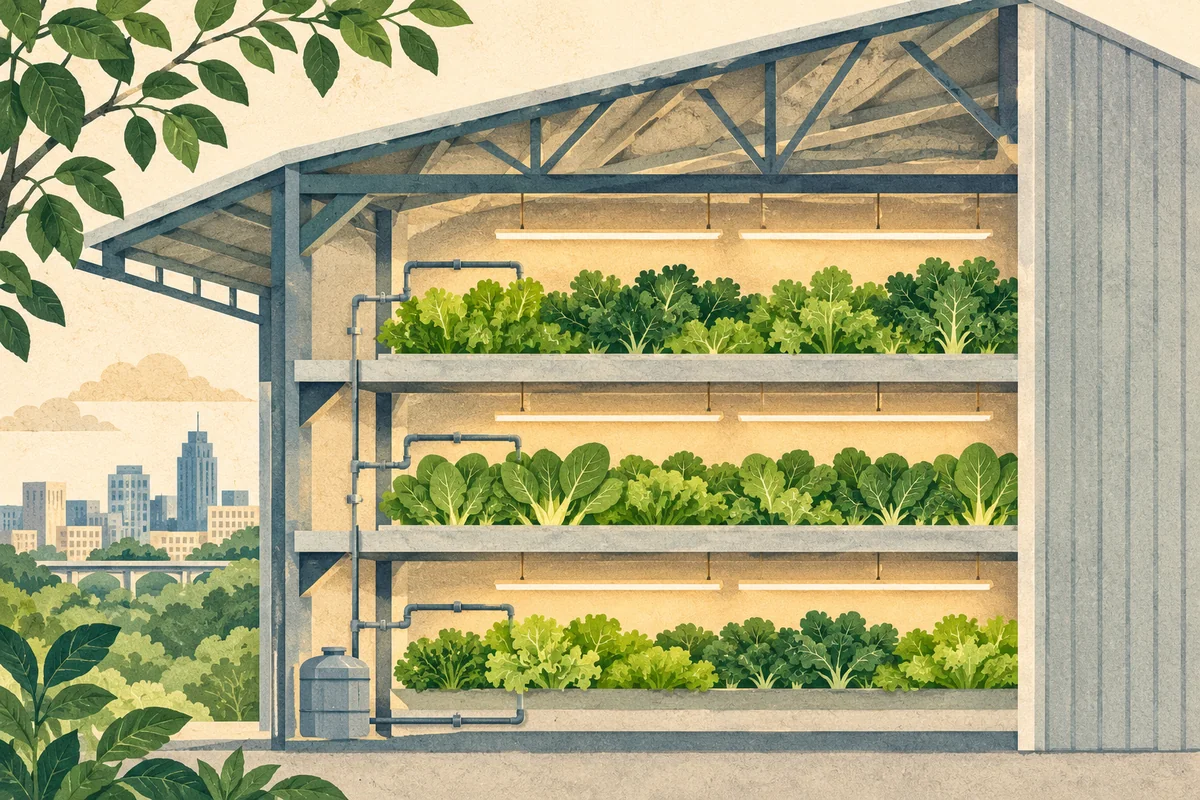
Picture an imagined warehouse with rows of leafy greens under lights. Stacking the plants makes a striking photograph, but the shelves are only the visible part of the idea. To understand the system, follow the conditions around the leaves: light, air, water, nutrients and the work needed to keep them in a useful relationship.
The interesting question is what moves indoors with the crop. A building can shelter plants from some outside variation while introducing a different set of decisions about equipment, energy, maintenance and daily operation. That exchange is a better starting point than a photograph promising that every empty building could become a farm.
The building is part of the growing system
USDA’s Economic Research Service examined controlled environment agriculture and agrivoltaics in its 2024 report EIB-264. The report considers innovation, adoption, agricultural output and the crops supplied, alongside economic and technical challenges. It gives readers a framework for asking what an alternative growing system actually produces and under what conditions.
For our imagined warehouse, that means drawing a wider boundary than the plant tray. Lighting and climate equipment belong in the picture, as do the water system, crop-handling area and route from harvest to customer. An explanation that stops at the rack leaves the reader unable to judge much of the operation.
Source: USDA ERS: Trends, Insights, and Future Prospects for CEA and Agrivoltaics, EIB-264, 2024
Choose a crop before imagining an industry
A useful proposal names the crop and the intended product. A tray of young leaves, a mature fruiting plant and a bag of grain are different growing tasks. Rather than treating a successful example as proof that every crop belongs indoors, ask what was grown, what its growth cycle required and what the system was designed to deliver.
Then ask how success was measured. Was the reported output a harvested crop, a saleable product or an estimate? What area and time period were used? Which inputs were counted? A reader can learn a great deal from those definitions before comparing a single headline number.
For example, imagine two hypothetical descriptions of a harvest: one reports the weight cut from the trays, the other the weight delivered to a buyer. Both can be meaningful, but they answer different questions. Keeping those boundaries visible makes a comparison more useful.
The future is in the whole description
Indoor growing is an interesting subject because it makes some usually invisible parts of food production easier to notice. Someone has to decide what conditions a plant receives and how the system responds when those conditions change. The building becomes part of the agricultural story.
A convincing account therefore shows more than a room full of healthy leaves. It explains the crop, the equipment, the measured output and the unresolved constraints. That is enough to make a warehouse farm worth reading about without turning a concept illustration into evidence that a particular business, crop or environmental promise has been proven.